AI Agents in Production: Observability, Evaluation, Guardrails, and Deployment
Part 5 of the AI Agent Tech Stack series. See also: Core Architecture · Design Patterns · Framework Comparison · Protocol Layer.
1. Observability
- Langfuse — open-source LLM observability (tracing, evaluation, prompt management)
- LangSmith — LangChain's official tracing and evaluation platform
- OpenTelemetry — standardized tracing for agent call chains
2. Evaluation
- Correctness — did the agent complete the task?
- Efficiency — how many steps/tokens were used?
- Safety — did the agent respect boundary constraints?
- Tools: DeepEval, RAGAS, custom evaluation suites
3. Security & Guardrails
- Prompt Injection defense — input sanitization, instruction isolation
- Output validation — Pydantic schema checks, PII filtering
- Tool permission control — least privilege principle, human approval for dangerous actions
- Tools: Guardrails AI, OpenAI Agents SDK built-in guardrails
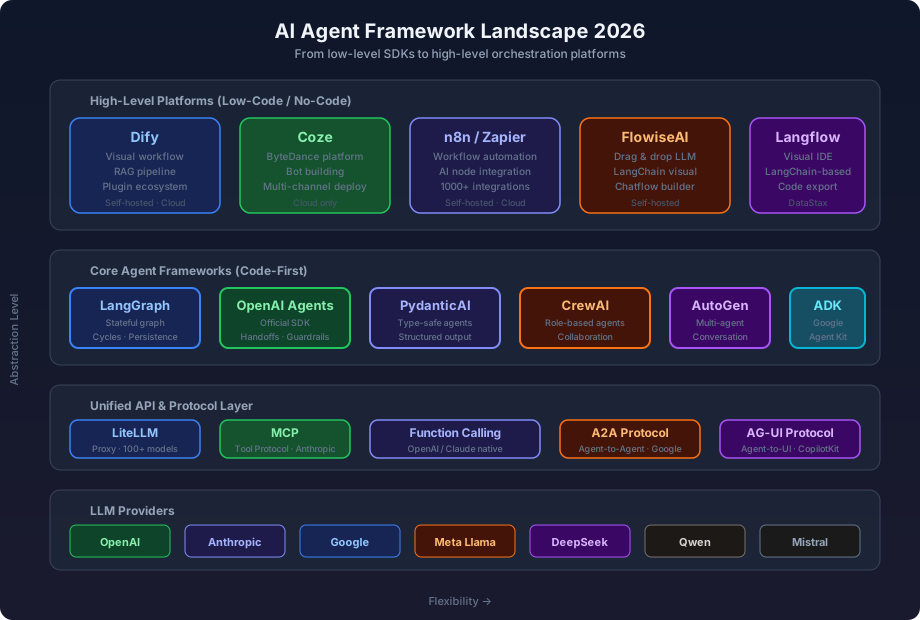
4. Low-Code Platforms
| Platform | Features | Deployment | Link |
|---|---|---|---|
| Dify | Visual workflow, RAG pipeline, plugin ecosystem | Self-hosted / Cloud | dify.ai |
| Coze | ByteDance platform, multi-channel deploy | Cloud | coze.com |
| FlowiseAI | Drag-and-drop LLM flows, LangChain visual | Self-hosted | flowiseai.com |
| Langflow | Visual IDE, code export support | Self-hosted / DataStax | langflow.org |
| n8n | General automation + AI nodes, 1000+ integrations | Self-hosted / Cloud | n8n.io |
5. Deployment Architecture
- LLM routing — LiteLLM as unified API proxy with failover and load balancing
- Async execution — Celery / Ray for long-running agent tasks
- State management — Redis / PostgreSQL for persisting agent state
- Containerization — Docker + Kubernetes for standardized deployment
Reference Links
Frameworks
- LangGraph · OpenAI Agents SDK · PydanticAI · CrewAI · AutoGen · Google ADK